Sunday, July 8, 2007

The political martyrdom of Joseph Ejercito Estrada

If memory serves, it was Lee Kwan Yew who said some years ago that “to name the enemy is to make him.” It is not a novel thought, but it is a truth worth keeping in mind when one speaks or does propaganda work for government. No government can afford not to know it, yet there is no sign that Malacanang propagandists were aware of it when they ran those full-page newspaper ads, “Erap: Guilty or not Guilty. Kailangan bang may gulo?”

Obviously they must have thought they were doing President Gloria Macapagal Arroyo a favor. That, they were preempting violent reaction from the opposition in case the Sandiganbayan finally convicts former President Joseph “Erap” Ejercito Estrada of plunder. The immediate result was a muddle of unintended consequences.


By that one mindless act, Mrs. Arroyo’s protectors succeeded in thrusting her, with or without her cooperation or consent, into the jaws of the tiger. By calling on Erap’s supporters to “let the law prevail” and not to react violently to his possible, if not probable, conviction, they made it sufficiently clear that his conviction was in fact imminent, and that they were afraid of the opposition’s reaction to it. That is naming, and making the enemy, indeed.


One columnist has taken up the cudgels for those behind the ads by asking, who can possibly be against “letting the rule of law prevail?” Let the courts decide, chorus the other defenders. Well, let us grant these defenders their good intentions, but let us ask them to look at things a little more deeply.


As a general principle, the courts should decide and we want them to decide. Where justice reigns, and justice and the rule of law are interchangeable, we want the rule of law to prevail. But where those in power have so casually misused the law for their own ends, and the courts do not have a record of standing up for what is right, regardless of the consequence; where the law has become a servant to power, instead of power being a servant to the law, we cannot really talk of a rule of law; we can talk only of misrule by law. This is the crux of the matter.


Because the Estrada case is in court, the court will have to decide. Yet it must decide on its own, and not just pronounce a decision made for it by others. It must not only decide justly; it must above all be seen to decide justly. But where the case is primarily, if not solely, political, can there be any just decision which does not declare the case political?


The question before the court is whether or not Estrada is guilty of graft and corruption, perjury and plunder. That can be decided either on the basis of the evidence, or on the basis of political pressure, if the court allows such pressure. But to a great many people, that is not the question at all. To them, the real question is constitutional, and involves one of jurisdiction----whether or not Estrada should be facing those charges at all, before he had fully served the six years to which he had been elected president in 1998 by the Filipino people.


It is settled jurisprudence that no President may be brought to court on criminal charges before the expiration of his elected term, unless he shall have been impeached and removed upon being found guilty of the charges against him in a Senate impeachment trial. Then and only then may he be formally accused in court of the same charges for which he had been impeached and removed, or of any other crime.


In Estrada’s case, he was impeached by the House of Representatives, but never found guilty by the Senate, where the court disbanded without concluding the trial. The failure or refusal of the prosecution to continue the trial against him and the Chief Justice’s failure to summon the prosecution back to court and reconvene the trial are, in fact, interpreted by some as amounting to the prosecution’s failure to prosecute, and to a verdict of acquittal.


For this reason, Estrada should never have submitted to the Sandiganbayan’s jurisdiction, just as then Opposition Senator Benigno “Ninoy” Aquino never submitted to the jurisdiction of the court martial that found him guilty and imposed upon him the death sentence under Marcos; just as Saddam Hussein never recognized the jurisdiction of the international tribunal that tried him, sentenced him to death, and carried out his execution.


But Estrada finally submitted to the Sandiganbayan’s jurisdiction, despite initial statements to the contrary. That, in our view, was a fatal mistake, for which he would have to pay dearly. So he cannot denounce Mrs. Arroyo’s apparent or real influence on the court now, or any of the judges’ suspected desire to please her, without confirming his naivete for having completely misread everything.


From the very start, it should have been clear to Estrada that once the cases had been filed against him, it was no longer a question of whether or not he would be convicted, but rather when they would convict him. Had he agreed to the administration’s proposal, after his removal, that he sign a formal letter of resignation, or go on self-exile in a country of his choice, he would not have been arrested and detained for his alleged crimes. He would have been a free man living a sybaritic and completely irrelevant life in some foreign land, instead of being detained in Tanay.


But he insisted on staying, so he must accept its consequences, the worst of which is now about to unfold. It is most unfortunate that while the sword is about to drop, the artificial alliances Estrada had tried to create during the last elections are also about to unravel in favor of the administration. The old opposition bloc that had argued about Estrada’s legitimate claim to the presidency and provided real opposition to the Arroyo government from his removal in 2001 up to the run-up to the last senatorial election has been replaced by an artificial group that took up the opposition label for the purpose of winning the election, while retaining its hidden ties with the administration. Some of the newly elected “Genuine Opposition” senators have now formed a new bloc in alliance with the administration to ensure Senate President Manny Villar’s reelection, at the cost of Estrada’s sacrifices for the opposition.


It is highly doubtful that any of his allies will risk anything now to demand real justice for him, which is the other word for his freedom. This will most probably remain the prerogative of people like former Vice President Teofisto Guingona, Jr., the man whose “I accuse” speech on the floor of the Senate on Oct. 5, 2000 had started Estrada’s long ride to Tanay. But the world may be forgiven for not being overenthusiastic about Guingona. His spiel about Estrada being a changed man, even if true, has little value except perhaps in a feel-good rally; the only relevant and worthwhile point he could make, and should make now, if he wants to right a grievous wrong, is to say that there was a grand political conspiracy to oust Estrada in 2001, that this conspiracy is continuing, and that the Sandiganbayan cannot afford to sentence Estrada even for a just single day in jail without transforming him into a political martyr.


Wednesday, July 4, 2007

The failure to inform, the failure to govern

One of the few blessings of our age is that you could always blame government for everything that goes wrong, even as it tries to claim credit for every little good thing that happens in spite of it. But can you ever blame media for their mistakes and get away with it? This is one of the more serious problems of our time.

The information revolution has made the media even more powerful than government. There is virtually no space, no crevice on the rock-surface where you may hide in order to escape their reach. In a globalized, unipolar world, world public opinion provides the only possible check to the might of the United States. Media is the other name for it.

In much of our planet, access to media defines one’s actual existence. The rich and the powerful exist because they have media access; the jobless don’t. As the unemployed in T. S. Eliot’s Choruses from the Rock puts it, “Our life is unwelcome, our death unmentioned in The Times.” In our own city, you are not officially dead until your obituary appears with the classified ads. At least, outside of the poorer classes.

Lest we be misled, the media are but mere instruments. Whether they are to serve truth or falsehood, good or evil, love or hate, peace or violence, prayer or pornography, grace or sleaze ---this all depends on the men and women who decide their structures, policies, and content. Thus, it is indispensable that those men and women have a clear view of what they, and the media, are there for, what grave responsibility they owe to the common good.

Unlike government, the media are not elected. They have no term of office, nor are their duties and responsibilities spelled out in the Constitution or statute. They are not obliged by civil law to be morally upright, responsible or intelligent, although these ought to be indispensable qualities. The possibility, therefore, of having an irresponsible, incompetent and corrupt media is not at all to be discounted, even when we believe we have a free press.

In recent months, international attention has been drawn to the growing number of Flipino “journalists” killed. This is truly tragic. The killing of any innocent victim is a scandal that cries to heaven for justice; but the killing of a journalist is not just a crime against a man or woman but a crime against the pursuit of truth and the free expression of ideas. It must always be denounced in the strongest possible terms. Yet for this reason, it is also absolutely necessary that the press report the killing of a journalist only when the victim was indeed a journalist, killed in the pursuit of truth and justice.

The position of the press is a privileged one. Its freedom may not be abridged; our Constitution forbids it. But while the state may not suppress that freedom, the owners, publishers, station managers, editors, news directors, producers, writers, reporters and correspondents themselves may yet succeed in doing so of their own accord. This happens every time they fabricate, falsify, or suppress facts to support their own agenda or bias, every time they allow their personal prejudices to rule the reporting or interpretation of the news.

I was at the 7th Doha Forum on Democracy, Development and Free Trade last April when the first balloting in the French presidential election was being reported on Al Jazeera, BBC and CNN. No one had a majority on the first round; Nicolas Zarosky led Sigolene Royal by some five points. He eventually won the presidency by a decisive majority in the second round in May. But in April all the commentators were uniformly saying that Sigolene Royal, who was trailing behind Zarosky, was on her way to becoming the first woman President of France. Without the least scruples, they were pushing a propaganda line not borne by the facts available to all the televiewers.

This is neither an isolated incident nor a monopoly of global television. It happens in our media all the time. It is not necessarily caused by malice, but usually by ignorance. Far too many novices are thrust into the most sensitive media assignments; and they soon get so focused on trying to teach their public they never find the time to study and learn. Some get inebriated too early with the smell of “power of the press;” they end up misusing their freedom, and turning it into what Prime Minister Stanley Baldwin once called, “freedom without responsibility, the prerogative of the harlot throughout the ages.”

A few years ago, the head of a prominent accounting and auditing firm wished he could “buy all the newspapers in the country so he could close down them.” I am not sure this is something he would like to repeat today. But the last senatorial election provides an occasion for sober reflection.

The senatorial campaign opened with an editorial headline in one of the leading morning papers---“Circus begins!” or words to that effect. Then for the next ninety days the same newspaper led the rest of the pack in selling tickets to the same circus it had previously scoffed at. The media first denounced the exclusive inept focus on artificial personalities, and the utter lack of discussion on political programs. Then they proceeded to do their silly and saccharine personality build-ups of their favorite candidates. Not a single newspaper cared to point out that for the first time in the nation’s history, three political parties were each running two sets of senatorial candidates on the two opposing tickets, and that not a single candidate on either side was saying anything about it.

Today they report, without comment, that Manny Villar will be reelected as a pro-administration Senate President, after having won his second senatorial term as an opposition candidate. They also quote, without judging, Senator Antonio Trillanes IV’s statements that his agenda is to seek the ouster of President Gloria Macapagal Arroyo, whom the 2003 aborted Oakwood Mutiny, in connection with which he had been charged and detained, had failed to oust.

In both instances, the media have failed to point out the obvious. In Villar’s case, the least the media could have done, or do, is to point out that one dark depth should not necessarily lead to another, and so soon, too. In the case of Trillanes, they could have reminded him, or remind him still that a neophyte senator will have a lot to learn before he could take on the world. Someone should recount to him the story of the young MP who sat beside Benjamin Disraeli. After listening to all the others for sometime, the young MP asked Disraeli, “Don’t you think sir I should now be heard on the floor?” To which Disraeli answered, “Maybe not, better that they should wonder why you are not speaking than they should wonder why you are speaking at all.”

These are some of the things the media can do in confused times. The media cannot assume that their failure to inform and to educate, where they could and should, will be more easily forgiven than the government’s failure to govern.

Saturday, June 30, 2007

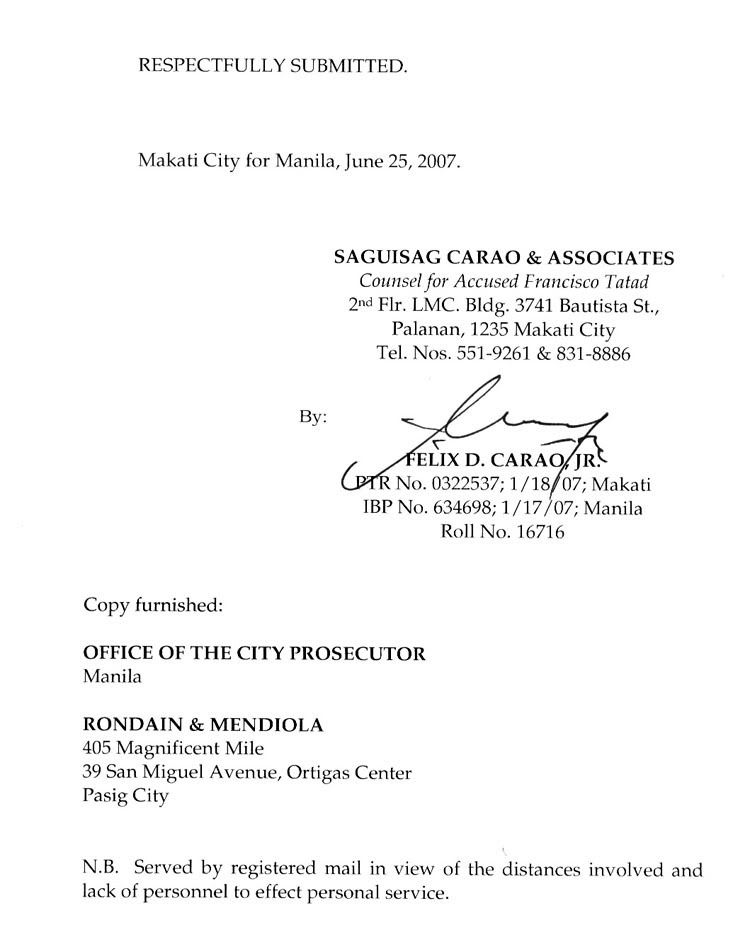
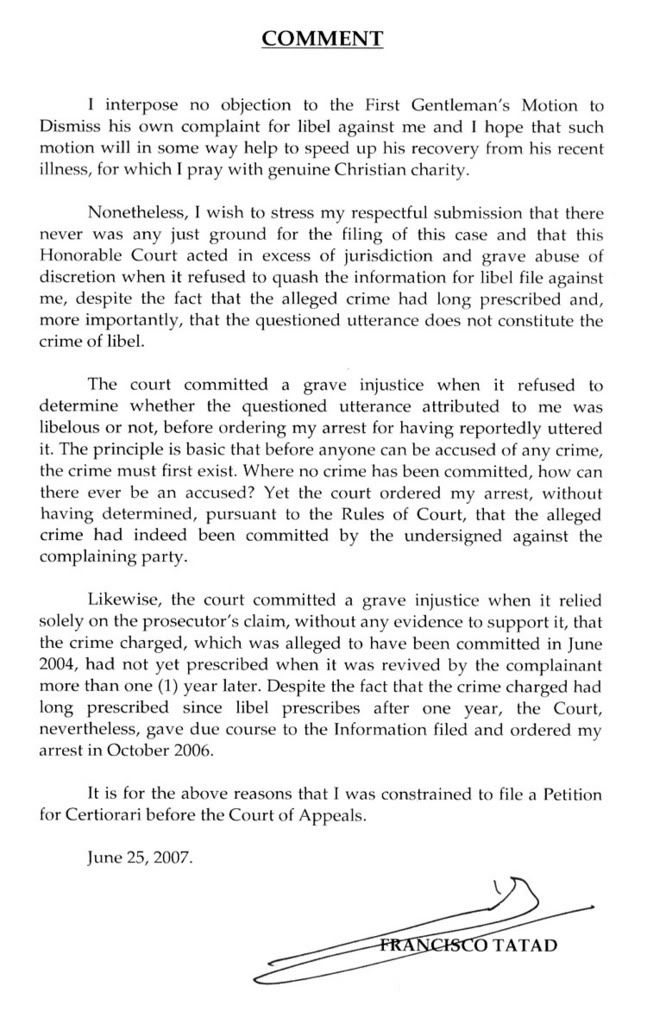
Updates on Libel Case


-------------------------------

Wednesday, June 27, 2007

Maguindanao, Trillanes and other Senate woes

Maguindanao, Trillanes and other Senate woes
By Francisco S. Tatad


At noon of June 30, twelve newly elected senators will begin their six-year term of office. But unless the responsible parties act now, only eleven senators will be sworn in that day. This should not happen at all.

All eyes are now on Maguindanao. Its votes will decide the fight for twelfth place between Aquilino “Koko” Pimentel III of “Genuine Opposition” and Rep. Juan Miguel Zubiri of Team Unity.

Both are from Mindanao, and running for the Senate for the first time. Zubiri has served three successful terms as congressman of the third district of Bukidnon, while Koko has failed in his maiden political bid. This happened in 2001, when he ran for mayor of Cagayan de Oro, while his father Aquilino “Nene” Pimentel Jr was Senate President.

As of now, Koko leads Zubiri by a little over 100,000 votes in the national count, minus Maguindanao. But in Cagayan de Oro itself, Zubiri placed third, while Pimentel landed sixth only. In the 21 municipalities of Maguindanao, the certificates of canvass (CoCs) show 186,518 votes for Zubiri, and 58,622 votes for Pimentel. The 127,896 margin should put Zubiri ahead of Pimentel by at least 16,000 votes.

Pimentel has asked the Supreme Court to restrain the Commission on Elections from canvassing the Maguindanao CoCs. But the Court has declined to do so. It simply scheduled oral arguments on June 28, which is cutting it too close to June 30. So not having been ordered to stop, the Comelec has proceeded to canvass the CoCs.

Were the Maguindanao CoCs to be excluded, a new election would have to be called in the area, to decide who would be the twelfth senator. Otherwise, the whole of Maguindanao would be completely disenfranchised as far as the senatorial race is concerned.

But how would that affect the local officials who would have assumed office by then? Would the Court split the May 14 ballot in Maguindanao, and declare the votes for the local candidates are valid but not the votes for the senators?

That would create a nasty constitutional and political situation which would not be easy to resolve. It appears that the best remedy for Pimentel, should he finally lose, is to do what Fernando Poe, Jr. did, after losing the 2004 presidential elections, which millions believed he had won.

Even if Koko should finally lose, he would still be serving the Senate, and even better, by saving it from a second political dynasty, after the Cayetanos. Were he to make it, the Senate would have two Pimentels, and bearing the same names too. This would present a daily problem to the presiding officer, and no one would be obliged to take us seriously anymore.

As of now, the Senate has to contend with two Cayetanos. Not all the voters saw this anomaly before the elections. Many, if not most, of those who had voted for Rep. Alan Cayetano were those who genuinely admired his showmanship in the failed impeachment debates and his uncanny ability to get the goat of the First Gentleman, Mr. Mike Arroyo. Many were not aware there was already a Senator Pia Cayetano. But now they know.

What is to be done then? Since more people seem to be aware of Alan’s political prowess than that of his sister Pia, there should be no harm in Pia resigning motu proprio or going on a permanent leave of absence without pay. This would require character, but there is nothing to prevent those who voted for her in 2004 to ask her to consider it seriously.

What to do with Senator Antonio Trillanes IV is the Senate’s next problem. He and former Senator Gregorio Honasan ran for the Senate while under detention for their alleged role in the aborted 2003 Oakwood Mutiny. Honasan had been granted bail before the election, and Justice Secretary Raul Gonzales has now moved for the dropping of the charges against him on the ground of weak evidence.

But the administration seems resolved to keep Trillanes in jail even while the Senate is in session. This may be constitutionally debatable, and it may not be the wisest move for the administration. It could make Trillanes bigger than himself and the administration more unpopular than it needs to be.

Time will tell whether the people acted wisely or foolishly in making Trillanes senator. But his election does remove any risk of flight from the court’s jurisdiction. The state would, therefore, be well advised to grant him bail so that he could perform his official duties well. This is the only way people will know if they did right or not in sending him to this formerly august chamber. It would also soften the image of the administration.

Now, despite the numerical superiority of the opposition, they will not necessarily be united in electing the next Senate President. Conflicting ambitions for 2010 will tend to divide its members. What is likely to emerge is a coalition president, who can play with everyone. It will be the old values-free politics as usual.

How the Senate will conduct its inquiries in aid of legislation remains an all-important question. Some senators-elect have already announced their desire to ride high on their investigations. The chairmanship of the Blue Ribbon committee will be critical.

At one time, then Senate president Neptali Gonzales had suggested the possibility of abolishing the Blue Ribbon committee on the ground that it tended to divert the work of the senators from legislative work to police-type investigations. Senator Ernesto Maceda objected, saying it would render the Senate powerless vis-à-vis the President. Not only did the committee stay, other committees became equally aggressive in conducting inquiries that tended to look more like criminal proceedings.

The Senate would regain much of its lost dignity and prestige, if its committees conducted their inquiries in aid of legislation in the most suitable manner, without arrogant and uncouth members browbeating invited guests and making a mockery of basic human civility and correct parliamentary usage, and if it began to debate more ideas, not just exposes, in committee and on the floor.

Thursday, June 21, 2007

How Do We Rebuild The Senate?

How Do We Rebuild The Senate?
Francisco S. Tatad


Over a hundred persons were killed, and they broke the rules every step of the way, and we say we had a relatively peaceful and honest election. A full 25 million out of 45 million registered voters did not vote for a single senator, and we hear the "winners" say they had all received a "resounding mandate." A "landslide," the topnotchers say, and they now expect us to treat them as the first licensed timber for the 2010 presidential race.

In how many other countries do we hear such Newspeak? We must stop kidding ourselves.

We did not have clean and honest elections. The political assassinations drenched the originally non-violent process in senseless blood, and the shameless buying and selling of votes turned the whole country into a veritable whorehouse. This barangay sign tells it all: "No money, no vote!"

In Muslim Mindanao, where one suspects the recurring electoral anomalies are really part of the lingering Moro rebellion, the vote-buying was wholesale as usual, and the most scandalous cases involved senatorial candidates on both sides, and not just the tailenders.

Former Commission on Elections Commissioner Virgilio Garcillano, who was at the center of the 2004 electoral storm, did not operate in this election. But there was no shortage of alter egos and clones. Corrupt election officers operated on their own for local clients, without need of direction from central headquarters. But a new election mafia, controlled by the country's most pervasive corruptors, had reportedly privatized the special operations for senators, in a sinister plot to control the next presidential elections and own the next President of the Philippines.

For all the victory parties then, there were no real winners. Those who had high hopes for democracy and decency were the biggest losers. The system no longer works, except that our national politicians and so many among our people do not at all seem to realize it.

In this election, we posed three simple questions:

1. Is it right or wrong for a political party to run candidates on both sides---two with Team Unity and four with Genuine Opposition, or a total of six candidates, on the part of NPC; and one with TU and two with GO, or a total of three each, on the part of LP and NP? Isn't this the most loathsome example of " pamamangka sa dalawang ilog?"

2. Is it right or wrong for a senatorial candidate to spend hundreds of millions of pesos, which he or she may not even have the legal capacity to earn, just to land a job that pays an annual salary of less than one million pesos?

3. Is it right or wrong for anyone to run for the Senate while his father, brother, sister, uncle or aunt is sitting there until 2010?

None of the candidates cared to answer. Most of the voters did not care about the morals, motives, or manners of the candidates either. The majority did not vote for any senator; the minority that did, voted mostly for GO candidates, believing they represented the people's cause. The voters will learn many things yet in six years.

Of GO's two dynasty candidates, Alan Cayetano had an unsurprisingly easy time, while Aquilino "Koko" Pimentel III was, as we write, still sweating it out for the twelfth place.

To a great extent, Alan owes his election to his running battle with the First Gentleman, Mike Arroyo, which made him an opposition symbol in the eyes of many voters. Not every voter understood the dynasty issue, and many of those who did must have thought that if Alan had a sister sitting in the Senate, they should have heard about it. They had not.

In the case of "Koko" Pimentel, so many seemed to have the impression that "Koko" was but another name for his father, Senate Minority Leader Aquilino "Nene" Pimentel Jr., and that he was just running for reelection.

Should Koko finally make it, we shall see the Senate exactly as we had said it would look like ----an absurd assembly of 24 members (minus Sen. Fred Lim, who has just been elected Mayor of Manila), with four members coming from two nuclear families.

Should Nene become Senate President, the Pimentel-Cayetano position on political dynasties would then rule. Forget the Constitution, forget basic morality, forget plain aesthetics. In another election, they might be able to convert the entire chamber into the private family estates of just a few families.

Keeping Manny Villar as Senate President or choosing a dark horse would be one way of preventing such anomaly. Villar is not entirely guiltless on the dynasty issue; his wife Cynthia sits in the House of Representatives. But at least he does not have a son or daughter sitting with him in the Senate. If the contest were strictly limited to Villar and Pimentel, it is Villar, rather than Pimentel, whose presidency could lend greater dignity to the Senate.

But it will take more than that for the Senate to regain its lost honor and dignity. Its members must have a clear understanding of that honor and dignity, and must have the will and the ability to do what is needed to regain it. That may not be easy.

The last time I sat at the Senate gallery was when Villar took over the Senate presidency. Senate President Franklin Drilon had called the session to order, announced his resignation, and relinquished the chair to a presiding officer, Senator Juan Flavier, the Senate President Pro Tempore.

The chair noted Drilon's letter of resignation, but neither he nor the Majority Floor Leader Francis Pangilinan asked the body to act on the same. So the resignation was never formally accepted by the Senate. The chair then called for the election of a new Senate President. Villar was nominated, several senators seconded, the nomination was closed, then Pangilinan moved that the new Senate President be elected by acclamation. No objections were heard.

The chair then intoned, "As many as those in favor of the nomination, will they please say aye. And as many as those against, will they please say nay." That was a call to divide the house by a voice vote, not a call to elect by acclamation the unopposed candidate.

Thus, in one short ceremonial session, with all the players reading from a prepared script, they still managed to commit two unnecessarily inept errors. That would have been unthinkable, and unacceptable, in the earlier years. But things have changed. Just the kind of unparliamentary language that often goes into the Senate record and the total absence of ideas being debated on the floor tell us to what depths the institution had sunk and what kind of work needs to be done to rebuild it.

The Senate has a duty, among other things, to teach the nation what it does not know. This includes, and is not limited to, correct parliamentary usage. In a society shot through with corruption, the Senate must concern itself not just with the corruption of others, but above all with the corruption within Congress, involving its own members. In a society crying for change, it must be prepared to lead the move for sweeping and fundamental change, first by provoking change within itself and among its members.

Sunday, June 10, 2007

Can the Senate still make a difference?

Analysis

Can the Senate still make a difference?

By Francisco S. Tatad

The euphoria is contagious, and so many are ecstatic about the victory of most of the "Genuine Opposition" (GO) senatorial candidates. But success often breeds the wildest expectations, and these could rise and multiply, beyond the winners' limited capabilities. Time will tell.

For now, we need to examine some of the more troubling aspects of the elections. Not necessarily the cheating, which consumes everyone in anger and shame, but the voters' real participation, which may not be getting enough attention. We need to know how many really voted and how many did not, and how many voted without voting for any of the senators.

In polling over 18 million votes, the topnotcher took 40 percent of the country's 45 million registered voters. As her name was on almost every ballot counted, then her votes nearly equal the number of voters who had voted. With less than two million votes still out in Muslim Mindanao, 20 million appears to be the total number of those who had voted. That's less than 50 percent of the number of registered voters ---quite a drop in voters' interest in the senatorial race.

On television, a GO senatorial candidate, citing privately compiled data, has suggested that the voting turnout was no bigger than the number of votes polled by the senatorial topnotcher, although in some places, the topnotcher's votes appeared to be inexplicably bigger than the number of voters who had voted.

On the other hand, a senior officer of the Commission on Elections says that about 70 percent of the voters had voted, but that many voters did not vote for senators at all.

If the first theory is correct, then the election had failed to meet the first requirement of a genuinely democratic process. The principle of majority rule requires the participation of at least a simple majority --- 50 percent plus one ---- of all the voters. At least 22,500,001 voters should have voted in order to bind the 45 million voters and the rest of the nation. But if only a minority had voted, then the validity of the process is open to question.

This is not good for the Senate at all. For although senators are not impeachable, they are subject to resignation calls from the public like any other elected officials. Should any group decide to exploit this situation, the presidency may no longer be the only besieged and unstable institution.

If, on the other hand, the second theory is correct, then it means at least 31.5 million of the 45 million voters had voted; 13.5 million did not vote at all. But of the 31.5 million voters, 11.5 million did not vote for the senators at all.

Whichever theory holds, the net result is the same: 25 million of the 45 million voters did not vote for senators. This amounts to a successful, though undeclared, boycott of the senatorial polls. Nobody had called for such a boycott. The only thing that came close to a call was a solitary newspaper ad before election day, quoting this writer's speech to the Pasig Rotary Club in mid-April, which noted the candidates' refusal to take a principled stand on the simplest moral issue, and concluded: "None of them deserve our vote."

The silent boycott had one message for all: reform or perish. The meaning is flexible. Some could use it to restate their demand for regime change. Either by impeachment or by other means.

Since 2005, the opposition had tried to impeach President Gloria Macapagal Arroyo twice. In both instances, the opposition did not have the numbers. But the smartest performers on the floor played to the gallery and the tv audience and became instant celebrities, while those whose task it was to kill the complaint made a killing of their own. This did not bring any opposition leader --- not even the long-detained and undisputed leader, former President Joseph Ejercito Estrada--- an inch closer to replacing the incumbent.

Unless the opposition now controls at least one-third of all the members of the House of Representatives ----the required number to bring the Articles of Impeachment to the Senate, they might find it more useful to proceed against the most sinning Comelec commissioner instead. If they are joined by some administration congressmen, then they might succeed in removing at least one venal commissioner, and probably force the first election reforms before the 2010 presidential contest.

But whatever the opposition does, the senators should try not to talk crazy about impeaching anybody at all. Under the Constitution, the House has the exclusive power to initiate all cases of impeachment. And the Senate has the sole power to try and decide all such cases. The senator's role is to render "impartial justice" in case of an impeachment trial. It would be totally unforgivable it any of the senators today simply imitated the deplorable conduct of at least eight senators in 2000-2001 who publicly demanded Estrada's resignation even as they sat as senator-judges at his impeachment trial.

There are a few urgent things the senators can do though. They could initiate a few anti-poverty and anti-corruption reforms, electoral reforms, and constitutional reforms before the next presidential elections.

  1. The automatic appropriations law for the repayment of foreign loans must now be repealed. This law has led to grossly irresponsible over-borrowing, which has saddled the country with a humungous foreign debt, which reduces the country's productive capacity to nothing.
  1. The "pork barrel", which has become the most notorious source of syndicated official corruption, must now be scrapped through a shift to line-item budgeting. No lump sum appropriations should be left at the complete discretion of politicians and their confederates.
  1. The electoral system must be overhauled. The voters' list must be permanently cleaned up, the cheating syndicates destroyed, the voting computerized, the election inspectors restored, the cost and physical risk of running for public office brought down, as close as possible, to zero level.
  1. The constitutional ban on dynasties must now be given teeth. Henceforth, no person should be elected Senator while another person within the first to the third degree of consanguinity or affinity is serving as senator. And no two or more persons within the first to the third degree of consanguinity or affinity should be elected simultaneously as officials of the state and of any political subdivision, or as officials the same region, province, city, or municipality. Whenever two or more persons, so related to each other, aspire for elective office, the person who has previously served or sought election; or who is seeking the highest position, if all of them have previously served or sought election; or who is the most senior in age, if all are seeking the same position, or are newcomers, shall qualify for election.
  1. Senators who run for President or Vice President in the middle of their term should resign their position, instead of being allowed to continue as senator after losing their bid for higher office. Unless this is mandated by law, there will be a riot of ambitious and morally unfit senators, whose term expires in 2013, running for the two highest offices in 2010.

We must have constitutional reform as well. The senators should now agree – before it becomes a Jose de Venecia show all over again ---- that any substantial constitutional change should be proposed by the people's delegates in a constitutional convention (concon). Only if non-controversial, and of a limited scope and number, should Congress propose the amendments.

For instance, a proposal to shift from presidential to parliamentary government, or from unitary to federal system, must go through a concon. However, simple amendments to improve the presidential system may be proposed by Congress, upon a vote of three-fourths of all its members, pursuant to Article XVII, Section 1 (1).

The 1935 Constitution requires the two houses to sit in joint session when proposing amendments. The present Constitution does not. It is all up to them. But to keep the amendments under control, the two houses should sit as they sit, instead of meeting in joint session. A bicameral conference committee could then harmonize any disagreeing texts later.

The proposals could include the following:

1. A vote for the President is a vote for the Vice President.

(This is to avoid electing a President from one party and a Vice President from another, as has happened here a few times before.)

2. The President shall be elected by a majority of all the votes cast by qualified voters in a national election.

(Where there are more than two candidates, and no one has polled a majority vote, the two leading candidates will have a "run-off"---a second balloting, as we saw recently in France.)

3. The Vice President shall be the President of the Senate, but shall have no vote, unless he has to break a tie.

(This will lend stability to the office of Senate President, and allow a clear distinction between the majority and the minority in the chamber. )

4. The Senate shall be composed of such number of regional senators as may be determined by law. They shall be elected by the qualified voters of the regions.

5. No person shall be elected President for more than one term; Vice President for more than two terms; Senator for more than four terms; member of the House of Representatives for more than five terms; or to any local government position for more than six terms.

(This is to make some sense of the present "term limits.")

6. All political parties which have candidates for at least forty percent of all positions in a national election shall have the right to appoint election inspectors whose services shall be paid for by the state.

(This will restore the election inspectors system under the 1935 Constitution, and hopefully help make elections cleaner.)

Just because De Venecia has now entered the scene, there will be every attempt to bring in Malacanang as well. Mrs. Arroyo would do well to listen to the servant-leader of El Shaddai, her special adviser. Don't jump into the water. The Constitution assigns no role to the President in amending or revising the Constitution. Last year's two-headed fiasco should not be repeated at all.

Despite De Venecia and company, constitutional reform is now unavoidable. As the election has shown, nothing seems to work anymore. If we are to survive, we must straighten what is bent, and fix what is 'broke', as quickly as possible. It is here where the Senate, for all its warts and weaknesses, could yet hope, if it but tries, to make a difference.

******************

Monday, May 7, 2007

None Of Them Deserve Our Vote

NONE OF THEM DESERVE OUR VOTE

By Francisco S. Tatad

And here’s why:

  • In 2006, the administration tried to abolish the Senate. Had they succeeded, all incumbent and future senators would have been “abolished.”

  • Now reelectionist senators Ed Angara, Joker Arroyo and Ralph Recto are running on the same Team Unity (TU) ticket with Malacanang’s Mike Defensor, Butch Pichay, Chavit Singson and Miguel Zubiri, like long lost brothers.

  • Former Senators Tito Sotto and Tessie Aquino Oreta, who once called Mrs. Gloria Macapagal Arroyo a “bogus” President, are also running on the same ticket as Mrs. Arroyo’s candidates.

None of them can seem to find anything wrong with it. They can’t seem to imagine that decent people are simply outraged by it.

  • The “Genuine Opposition” (GO) candidates are not any better either. Except for a couple or so, they were never oppositionist at all. They simply know the people are oppositionist, and they want to cash in on that sentiment. They never sought electoral reform as a precondition for participation in the elections; now, they are demanding absolute honesty from thoroughly dishonest men and a thoroughly dishonest process. They can’t seem to understand that in order for us to have an honest election, we must first have honest and morally upright candidates.

  • The candidates have been very careful not to really offend the President they are supposed to oppose. More than that, none of them have taken a principled stand on the simplest moral issues affecting themselves or their friends.

  • None of them have said it is wrong for Aquilino “Koko” Pimentel III, Alan Peter Cayetano, and Mike Defensor to be running for the Senate while Koko’s father (Nene), Alan Peter’s sister (Pia), and Mike’s aunt (Miriam) are sitting there until 2010.

  • None of them have said it is wrong for senatorial candidates to spend tens or hundreds of millions of pesos, whether ill-gotten or ill-sourced, just to land a position that carries an annual salary of less than one million pesos.

  • None of them have bothered to ask, where is all that money coming from? Who will own those candidates, whether or not they get elected? How will they rip off the government in case they win, just to recover their expenses?

  • None of them have said it is wrong to have twelve senatorial candidates running against each other on the TU and GO tickets, but coming from the same parties. They do not even seem bothered by the fact that the press has said absolutely nothing about it, and that the voters may not even have heard that:

  1. The NPC has Oreta and Sotto in TU, and Loren Legarda, Francis Escudero, John Osmena and Nikki Coseteng in GO. A total of six candidates.

  1. The NP has Recto in TU, and Senate President Manuel Villar and Cayetano in GO. Three candidates.

  1. The LP has Defensor in TU, and Noynoy Aquino and Sen. Francis Pangilinan in GO, although the latter has opted to do a solo. Three candidates.

Nothing like this has happened before, no matter how rotten our politics. It plunges our politics into the deepest rotten pit. The candidates themselves do not mind lying in the sewer, provided it does not affect their unearned ratings in all the manipulative “surveys”. But we have no reason to put up with it. We cannot and must not let them get away with it.

  • A war has been thrust upon us. A war between the people and the politicians. Despite the fact that we may know or even like some of the candidates personally, they have failed in their basic duty as candidates, and we have no moral duty to get any one of them elected.

  • Our duty is not to help the opposition get rid of the administration or vice versa. Our duty is to get rid of both. We must replace an entire class of political opportunists.

I do not advocate a boycott. Every voter has to vote.

  • But I will propose that instead of filling up our ballot, we leave it blank or cross it with an “x”. Or write the names of the three Kapatiran senatorial candidates instead. This will be our way of saying, none of the TU-GO candidates deserve our vote.

  • We may not be able to prevent 12 undesirables from being “elected.” But if the number of protest votes is significant, then none of them would be able to claim a real mandate.

  • If on the other hand the number of protest votes exceeds the votes of those “elected,” then it means the majority of the electorate has rejected the candidates and the process has failed. We could then begin to consider the next steps.

May God be with us. Mabuhay ang Pilipinas!

The foregoing are excerpts from a recent speech delivered before the Rotary Club of Pasig.

--Courtesy of Philippine Democratic Caucus

Is Democracy Picking Up?

Special report on the Doha democracy forum:


Is democracy picking up?

Francisco S. Tatad

At the invitation of the Emir of the State of Qatar, Sheikh Hamad bin Khalifa al Thani, conveyed thru the Qatari ambassador in Manila, Abdulla Ahmed Al-Muttawa, I attended the 7th Doha forum on democracy, development and free trade on April 23-25, 2007. This was the seventh annual round of what undoubtedly is the most focused and fascinating discussion on these issues at this time anywhere in the world.

The Emir opened the forum, followed by President Taria Halonen of Finland and UN Secretary General Ban Ki-Moon who led the assembly of some 600 statesmen, politicians, scholars, and experts from 70 countries. Among the most notable participants were former presidents Fredrick de Klerk of South Africa and Emil Constantinescu of Romania; Britain’s former foreign secretary and now Leader of the House of Commons Jack Straw; General Secretary Amr Moussa of the League of Arab States; and former prime ministers Saleem Al Hoss of Lebanon, Mawloud Hamrouch of Algeria, and Thaksin Shinawatra of Thailand.

Non--Arab participation stretched around the globe, from Asia to Africa, through Canada, America, Europe, Scandinavia. But the Gulf states provided the bulk of former ministers and scholars, and Britain, the strongest non-Arab presence. From Southeast Asia, a Singaporean civil servant gave an impressive briefing on training executives; a Malaysian lady professor spoke on the role of women in development; Thaksin read a well-nuanced paper on democracy; I took part in the floor debates.

Covered live by Al Jazeera, Doha’s answer to BBC and CNN, the debates at the Ritz Carlton ran deep into the night. The Emir set the tone when in his address he said that political reform in the region should proceed at a more agreeable pace, but not on account of any pressure from outside. For his part, Ki-moon said the intrinsic value of democracy must be viewed on its own terms, regardless of its positive effect on trade and development.

The sentiment was strong. But the question was whether democracy should be imposed from outside, and whether or not those calling for it were credible enough. Jack Straw said no two democracies had ever gone to war against each other. To which Moussa quickly replied: “But have you not seen so many democracies attacking other countries? You cannot use democracy as an excuse to attack and rule others.”

In the most pungent remark at the forum, an Arab university professor said that while the Middle East covers no more than nine percent of the earth’s surface and holds only four percent of its population, it accounted for 36 percent of all violence recorded last year. He did not think political reform was possible. He believed the region’s future lay in the hands of external actors.

A Canada-based Iraqi professor said democracy could not take root in a region where people were being “slaughtered” in its name. Algeria’s Hamrouch said democracy would be rejected if imposed from outside. “We don’t want the West to intervene,” declared an Egyptian writer-activist. “Imposing democracy will not lead to democracy,” said the director of a Washington-based think tank.

Recalling the Allied Powers’ role in postwar Germany and America’s in postwar Japan, the director of the International and Strategic Studies Institute in France said not all intervention was bad. Except that the Middle East is not an aggressor and has done nothing that even remotely resembles the German and Japanese war crimes which had obliged the victorious powers to intervene in the postwar reconstruction of the two aggressor nations.

If the Middle East is so highly penetrated, it’s because its geopolitical importance makes intervention inevitable, an Islamist scholar from Durham University in Britain explained. The critical question, however, was --- is the intervention led by force, by example, or by persuasion? Even more critical: is the political culture of the place ready to receive democracy? If no, only greater instability will ensue, as in Iraq.

In a globalizing world, democracy has ceased to be a “Western thing.” It is now the common patrimony of mankind. But in a region rich in history and culture, and ruled for ages through hereditary succession, the transfer of political power through regular elections, which is basic to a democracy, is not an easy or simple question. This does not exempt certain forms of government from governing well.

South Africa’s De Klerk, who played a pivotal role in ending apartheid, recalled that in a period of absolute monarchs in most of Europe, the 18th century Englishman enjoyed the protection of a reasonably independent legal system, which put effective constraints on the power of English kings and governments to do as they pleased. It is the rule of law and respect for human rights that ultimately ensure the growth of permanent democratic institutions.

Qatar, with is visionary leadership, is obviously on track. Under a new Constitution which took effect in June 2005, Qatar has decided to shift to democracy. This year it held its first parliamentary elections, and women were allowed to vote and be voted upon. Qatar chairs the New and Restored Democracies Movement, is a major contributor to the UN Democracy Fund, a supporter of freedom of the press and of worship, which is highly valued by its non-Muslim migrant population, nearly 75,000 of whom are Filipinos. It has become the latest center of dialogue on the most important questions, like the WTO Doha round. It stands as a class by itself, in world affairs.

The Arabs alone will decide how fast and in what direction they will go. But a great deal will depend on how they perceive the performance of the practicing democracies. The pace could pick up if the region sees the democracies becoming irrevocably linked to the promotion and defense of human dignity and human rights, the genuine search for peace, the just sharing of knowledge and resources, and the determined effort to make the dialogue of nations, cultures, and civilizations produce the desired results. Yet it could slacken if the democracies become identified with the moral corruption of society or the arrogant use of power.

I am confident that, at the very least, some variant will take root in the Middle East when democracy begins to work the way it should where it should. Thus it worries me no end when some democracies try to promote the rule of law through the rule of force; when they seek peace at home by waging war abroad; when they defend the human rights of their citizens by denying the human rights of others; when they seek to avenge the death of their combatants abroad while bearing no discomfort whatsoever over the routine murder of millions of innocent unborn, by some perverse authority of the state.

Indeed, it worries me no end when a country that had first sought to establish a democratic government upon its revolution against Spain in 1898, lost it to the next colonial master, but regained it 48 years later, and became known since then as the “showcase of democracy” in the Third World is now beginning to look like a failed state.

*************